If your shelf holds 45 days of product and your supplier wants payment in 30, you have two options: pay for a third of every order before it sells, or pay late.
In New York, paying late now has consequences. Retailers there have 30 days from delivery to pay suppliers, and anyone who misses the deadline goes on the state's cash-on-delivery list until every overdue invoice is paid, according to the Office of Cannabis Management. Since September, OCM has tracked it through Metrc, and that month the list held 87 retailers owing $3.9 million combined, MJBizDaily reported. Washington is stricter still: retailers paying by check have to send it by the first business day after delivery (WAC 314-55-115).
Everywhere else there's no list, but the math is the same: you're either fronting cash for product that hasn't sold or putting off your vendors. Either way, the fix is smaller orders, placed more often, sized to what each product sells.
The short answer: cannabis retailers pay suppliers on time when product sells before the invoice is due. The most reliable way to get there is ordering every one to two weeks, keeping days of supply below your payment terms, and sizing each order to what that product sells.
Why big orders lead to late invoices
Days of supply is how long the product on your shelf would last at your current sales pace: units on hand divided by average units sold per day. A pre-roll with 60 units on hand that sells 2 a day has 30 days of supply.
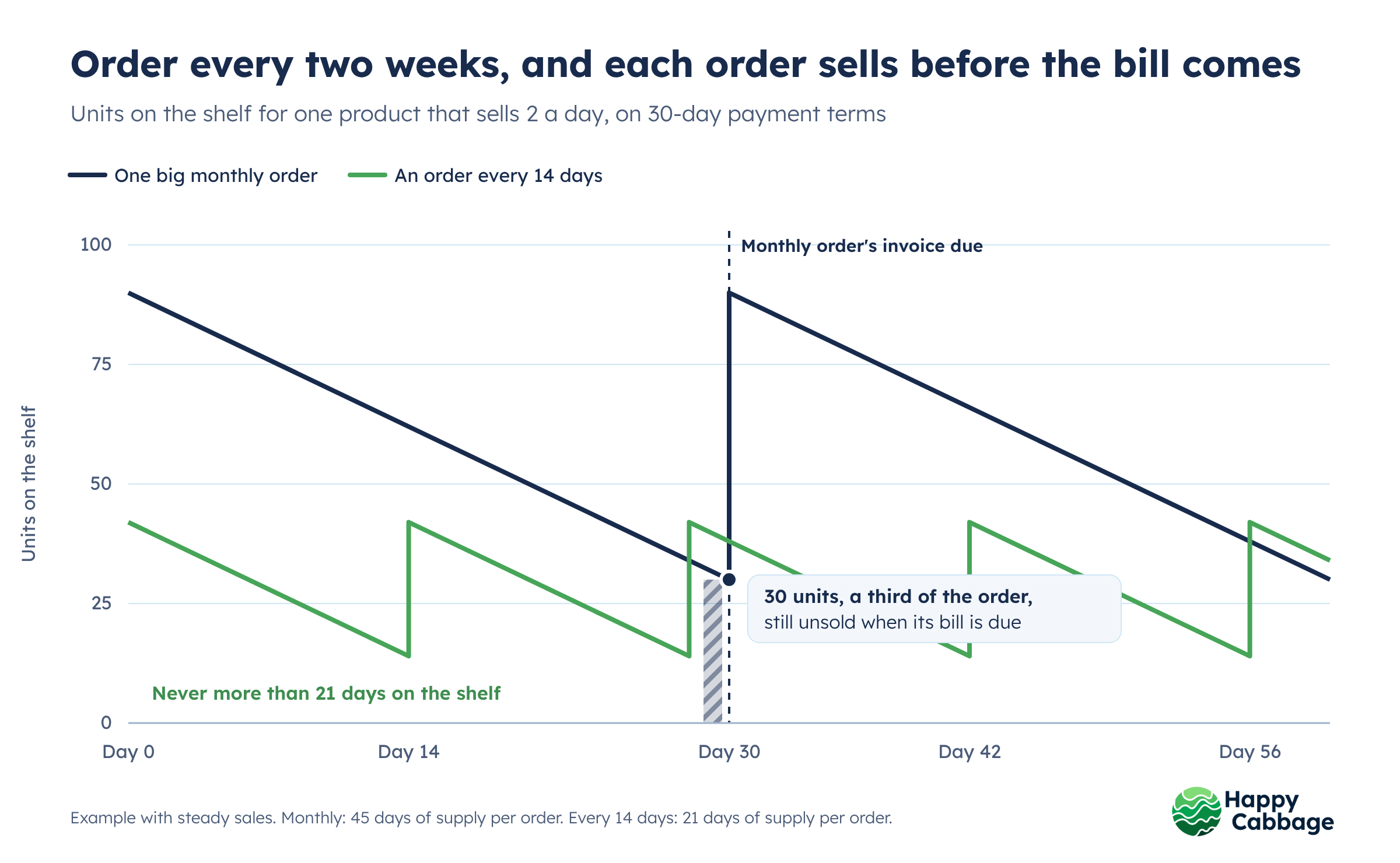
Compare that number to your payment terms. At 30 days of supply on 30-day terms, product sells as the bill comes due. At 45 days, a third of the order is still sitting there, and you're covering it with cash from somewhere else.
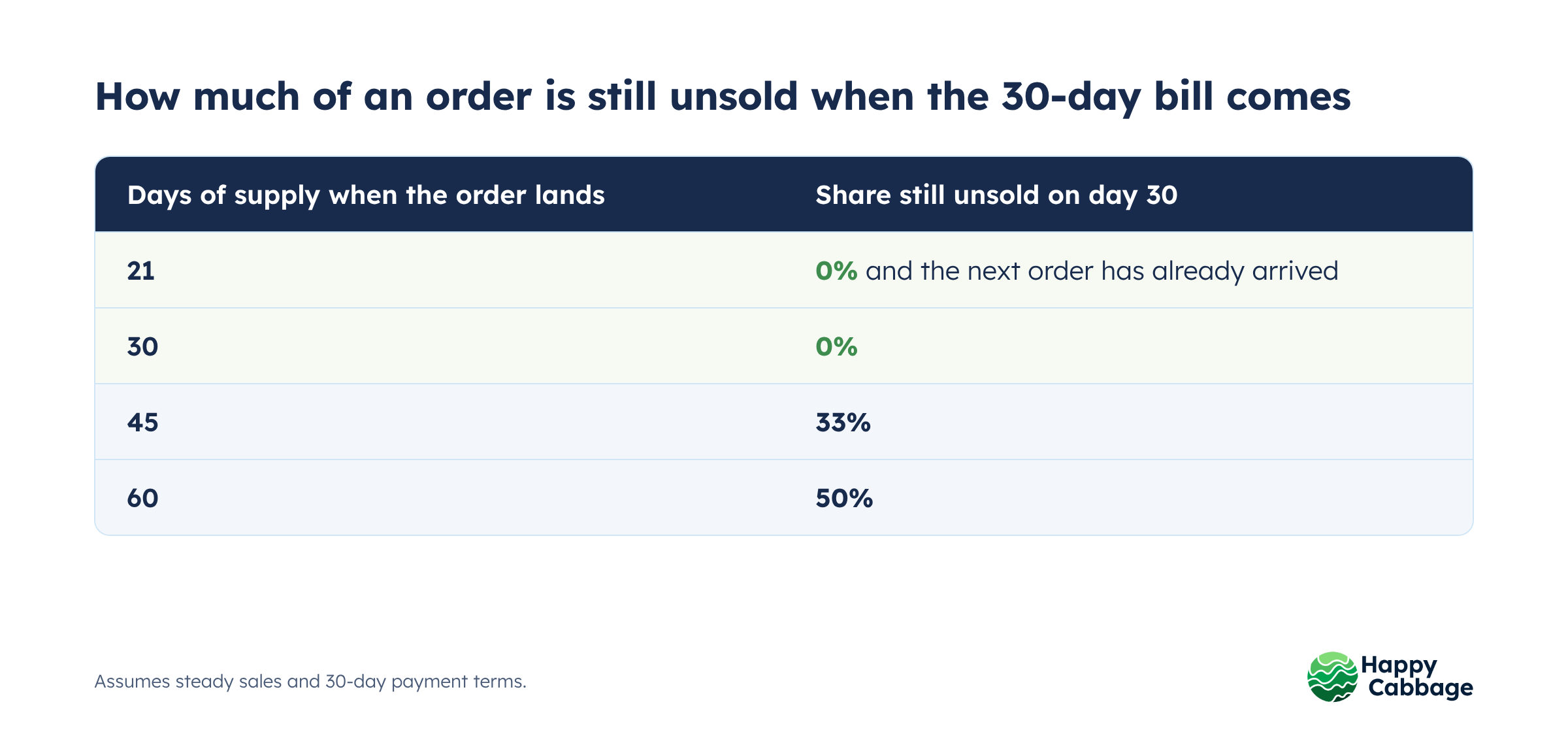
Big, infrequent orders push that number up by design. If you order once a month, every order has to last a month plus a cushion for late deliveries, so you start each cycle well past 30 days. Retailers quoted in MJBizDaily put sell-through at 45 to 60 days, and across retailers who start on Happy Buyers, the typical store sits on about 57 days of supply (Happy Buyers platform data, 2026).
Why smaller, more frequent orders work
The first payoff is cash. When an order only has to last one or two weeks, most of it sells before the invoice comes due, so the bill gets paid out of the sales it created.
Rosemary Slade, a manufacturer's rep for Kanha in California, prefers it from the brand side too. On our Buyer's Blueprint webinar, she said:
"I would rather send you smaller orders more frequently than larger orders less frequently."
Her reasons: she gets more touchpoints with the store, and she's confident the retailer can sell through the inventory before the invoice is due. She described Damon Crain, who owns Doobie Nights in Santa Rosa, as a retailer who moved to smaller, more frequent orders on his brands after overbuying ahead of 4/20. That change, she said, has been really helpful for his cash flow, and he pays on time all the time.
Damon runs about 34 days on hand and orders every two weeks. He's blunt about what product past 30 days does to a small store:
"If they sit past the 30 day mark, it's a liability, not anything you can use to run your business."
The second payoff is fresher product. Damon asked a distributor that already drove past his store several times a week to drop two or three eighths of each SKU weekly instead of a big monthly order. Now he gets fresh flower in small amounts every week.
"Nobody wants to go to the farmer's market and see the booth from last month."
The third payoff is less risk on new brands. Damon caps any new brand at $1,000 and tests it in small quantities before buying more.
What smaller orders cost, and how to keep it low
Smaller orders aren't free. You can lose volume discounts, pay more delivery fees, run into brand minimums and spend more hours building orders. Each of those has a fix.
- Volume discounts: buy from fewer brands. CONBUD's CEO, Coss Marte, said on our webinar that the way to get better margin is buying more volume from fewer brands, which means cutting the bottom performers. A tighter menu means each brand still gets meaningful orders.
- Delivery fees: compare the fee to the cash you'd tie up. Beryl Jackowitz, National Buyer & Merchant at The Botanist, said she'd rather pay a $60 delivery fee per store than take four extra cases to hit a minimum.
- Brand minimums: Damon asks brands if he can break a case. He also asks reps to stop in when they're already driving through his town.
- Ordering time: stop building orders by hand. Ordering every week only works if each order takes minutes. Peter Mercado, Director of Buying at CONBUD, estimates Happy Buyers saves him about 20 hours a week.
How to switch to smaller, more frequent orders
- Pull days of supply by category, then by product. Category shows where the cash is stuck. Product level tells you what to change on the next order.
- Set a target below your terms. On 30-day terms, aim for 14 to 28 days of supply so a slow week doesn't push you over.
- Pick a cadence. Reorder every one to two weeks, matched to your suppliers' delivery days. Andrew Watson, CEO of Happy Cabbage, gives the best-in-class rule as turning your inventory over twice inside your payment terms, which on net 30 means ordering every 14 days.
- Size each order to demand adjusted for stockouts. When a product sells out, your POS records lower sales than the shelf would have produced, so an order built off raw sales comes in short on your best sellers.
- Order similar products as a group. If five strains from one brand rotate on your menu, customers buy whichever is in stock. Order each SKU off its own history and you'll overbuy the line.
- Cut the slow movers. Anything that has sat past 30 days is already paid for or due. Figure out why: you might be over-ordering it, it might not fit your customers, or the category might need a different brand.
What it looks like when product sells before the bill comes
CONBUD, three stores in Manhattan, runs about 17 days of supply. Only 0.8% of its inventory is more than 90 days old, the lowest among Happy Buyers users (CONBUD case study, 2026).
The Botanist, 11 stores across Ohio, New Jersey and Massachusetts, went from 41 days on hand to 24 between November 2025 and February 2026 and cleared $588,000 in overstocked and aged inventory. Beryl described where they started:
"We were overbuying, which meant we had too much inventory, too much aged inventory, and we weren't turning inventory before we paid the bill."
Their cash conversion cycle, the gap between paying for inventory and getting paid for it, went negative. They now sell product before they pay for it.
In New York, stores join Happy Buyers at about 40 days of supply. The ones using it every week run a median of 28 (Happy Buyers platform data, four weeks through October 12, 2026), so on 30-day terms, product sells before the bill comes.

Order for the next two weeks, not the next two months
A store that orders every week or two, sized to what sells, pays its suppliers out of sales instead of savings, gets fresher product and takes less risk on every new brand.
Not sure where your days of supply stand? Book a demo
FAQ
How often should a dispensary order inventory? Most retailers do best ordering every one to two weeks and keeping days of supply below their payment terms. On 30-day terms, that means 14 to 28 days of supply on hand.
Are smaller, more frequent orders more expensive? They can cost more in delivery fees and lost volume discounts, but over-ordering usually costs more. Product that sits past 30 days tends to get discounted to clear the shelf, so you give up margin on stock you've already paid for. Retailers who start with Happy Cabbage have, on average, at least $50,000 a month in overstocked or aged inventory (2026). Buying from fewer brands, breaking cases and lining orders up with delivery routes keep the costs of smaller orders down.
What is days of supply in cannabis retail? Days of supply is how long current inventory would last at the current sales pace: units on hand divided by average units sold per day. It shows how much of an order will still be on the shelf when the invoice is due.
What are the payment terms for cannabis retailers in New York? Retailers must pay suppliers in full within 30 days of delivery. Suppliers have seven more days to report overdue payments to the Office of Cannabis Management, and late retailers go on the cash-on-delivery list until every overdue invoice is paid.
What happens if a New York dispensary pays a supplier late? It goes on the state's C.O.D. list, which OCM updates every Wednesday. Suppliers can't sell it product on credit until the debt is paid, and repeat failures can put the license at risk.
About the author: Courtney (Quart) Hellendrung is Head of Marketing at Happy Cabbage, the company behind Happy Buyers, ordering software for cannabis retailers. She has more than nine years of marketing experience, and for the last three she's worked in cannabis, helping retailers get better technology. She also moderates conversations with cannabis buyers and brand reps on The Buyer's Blueprint, Happy Cabbage's webinar series.