.svg)
.svg)
Using AI for cannabis ordering and menu planning is easy to get excited about. Making sure what it's giving you is accurate is another story entirely.
Anyone who's used AI, us included, has seen both sides of it. The good part: it schedules tasks, drafts quick summaries, and gets you a first pass on an order in seconds. The bad part shows up just as fast: it stalls out mid-session, invents a context it doesn’t have, and hands you a wrong answer with 100% certainty.
When it comes to ordering and menu planning, our CEO Andrew Watson puts it plainly, if you're about to spend $30,000 on an order through AI, you want to make sure the math behind it is correct.
Where AI is pulling those numbers from is what determines the accuracy of what you get back.
If you're not sure whether what you're getting is accurate, or you want to start limiting AI hallucinations in your own ordering, this is for you.
What AI is good at
AI is good at reading, comparing, drafting, and explaining.
Ask it to match products across a messy PDF, a Google Sheet, and a live wholesale marketplace listing, and it's good at that. Danny Gold, our COO, drew the line exactly where it belongs during our AI ordering webinar.
"Where the LLMs really come in is product matching. Is this product, this product? I got a Google Sheet, I got a PDF, I'm looking at the Apex Marketplace. How do I match these products and find similar products? That's really where leveraging an LLM like Claude is going to pay dividends."
What AI sucks at (and where it gets costly in ordering)
AI doesn't have the ability to know whether or not anything it's produced is informational.
Point an AI directly at a POS export or a full sales history, thousands of SKUs deep, and it doesn't just risk a wrong answer, it also burns through credits doing it.
The sell-through data that AI is looking at will tell you what left the shelf. It doesn't tell you what would have sold if the product had been in stock, priced normally, and not sitting behind a case of something else.
Pulling straight from that raw source costs you twice: more tokens spent reading it, and a less reliable number at the end.
Danny explained the mechanics directly, "Avoiding trying to just raw pull a bunch of raw information from the POS without that inference layer, it is incredibly expensive, it is incredibly token heavy. And because it hasn't had these rule sets and logic layers built in, it's going to give you likely answers, and it's going to tell you to way overstock and way overblow your menus."
Here are a couple of scenarios AI can't account for with POS data or exports:
The order that comes back three times too big.
Say you carry a product with 12 rotating variants, and only 2 to 4 are ever in stock at the same time. Ask an AI to reorder it based on raw sales history, one SKU at a time, and it will recommend restocking all 12, each sized to what it sold while it happened to be on the shelf.
The problem there? You'll get an order that is three times the size of what you need.
The AI is just doing the math you asked for, one SKU at a time, but your customers were never buying twelve things, they were substituting between whatever was in stock. AI pulling SKU-by-SKU data has no way to separate that out.
The "bestseller" that was just a markdown.
"Everybody has the story. We'd just gotten off a call with a customer who said: I'm using these VMI reports from brands, and they keep telling me that I've got this fast mover that I need to restock. And it was a fast mover because I discounted it 50% to clear it out. If we're just using general data, it's like, oh man, this thing is awesome, this thing is selling twice as fast as it used to be, let's order ten cases of it."
That customer almost restocked ten cases of a product they were actively trying to clear off the shelf, because a VMI report calling it a "fast mover" had no way of knowing it had been marked down 50% to get rid of it. A markdown and a real trend produce the exact same shape in a sales report. When nothing in the raw data flags this, AI won’t catch it.
"The thing to always remember about every AI platform you use is it's non-deterministic. You can run it five times, and two of those times you might get different results."
Keep the math in a system you can trust
Andrew's practical version of building confidence in AI is to be specific about what you're asking for and where the data comes from.
"A lot of people, maybe they played around with AI a little bit, and they're like, oh, this is going off the rails. Oftentimes it's because you're not giving it enough specificity as to what you're looking for, and it's important to make sure you're pointing it at a good data source"
In Happy Buyers:
- Product-line logic caps the order at what the whole line can actually move.
- You can mark products as discontinued, so even when they sell fast at the 50% discount, you know not to restock.
- Block-out dates make sure you'll never let the 420 rush skew your data again.
- Run rates, days on hand, and inventory health are hard-coded into the platform, not calculated every time you open up a chat.
- All the data is cached every night, so when you pull it into an AI, it can use that data that was rolled up accurately .
It's also just faster. Two years went into a UI built to hand you that math instantly:
"We've spent two years making our UI give you instant access to some very complicated math and very complicated demand planning, and it's fast. It's faster than Claude for some of the hunt and gather."
Connect an AI agent to that, and you improve accuracy and reduce your token costs.
Watch the full sessions
Ordering Accurately with AI Agents and Happy Buyers →
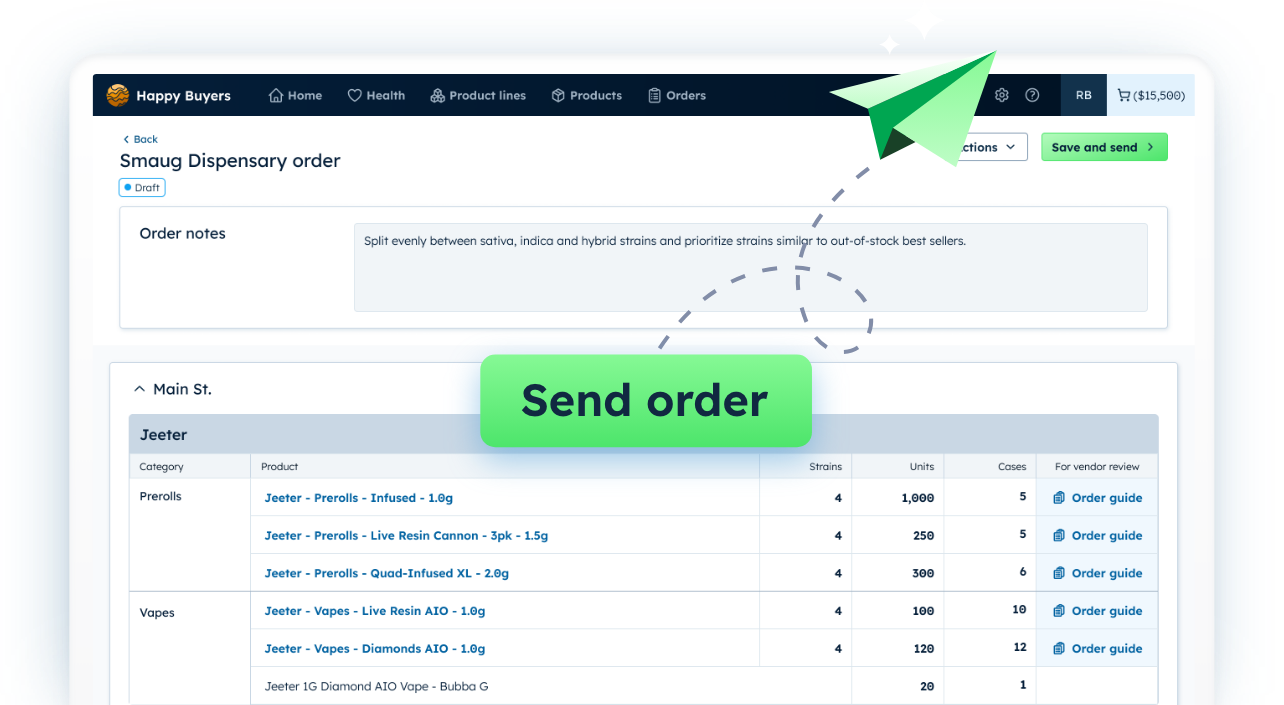
Six AI ordering workflows demoed live: a single brand, a full product line, a wholesale Excel menu, a brand menu that lives on Apex Trading, a vendor menu that lives on Apex Trading, and scheduled draft orders waiting for you Monday morning.
Menu Planning with AI Agents and Happy Buyers →
The five-step menu planning framework, a real (anonymized) store carrying over $100,000 in slow-moving inventory, the markdown near-miss above, and a live $2 million gap found by pointing an agent at nearby competitors' menus.
Try it on your own numbers
Our AI Hub hosts a prompt library we used live on both webinars, copy-and-run, and the how-to videos broken out by workflow. It's meant to be a page you keep coming back to as we add to it.
If you are a Happy Cabbage customer and want help setting any of this up, or an API key to connect your own AI tool, reach out to success@happycabbage.io.


.png)
.png)
.png)