See us at NECANN in Boston, MA, March 21-22, 2025 at Booth #1621
|
Webinar: Join Us June 25, 2025 @11 AM PST for The Buyer's Blueprint w/ Angela Pih - Register now


.svg)
.svg)

The Botanist is a multi-state cannabis retailer operating 11 dispensaries across Ohio, New Jersey, and Massachusetts. Known for its thoughtful retail experience and disciplined approach to assortment and merchandising, The Botanist focuses on making cannabis more approachable for everyday consumers while maintaining a strong emphasis on product quality, education, and customer experience.

Before Happy Buyers, purchasing at The Botanist depended on spreadsheet workflows built from Dutchie exports.
Inventory decisions were managed through manual reporting, VLOOKUPs, pivot tables, and disconnected spreadsheets across stores. At the time, the company did not yet have a formalized buying department.
That made it difficult to:
• Standardize purchasing decisions
• Track inventory KPIs consistently
• Scale buying across locations
• Onboard dedicated buyers
• Manage inventory with precision
As the business evolved, the team needed a system built specifically for retail buying.
The Botanist evaluated several solutions before choosing Happy Buyers. The major differentiator for them was the Product Lines feature set.
Instead of replenishing inventory SKU-by-SKU, Product Lines allowed the team to evaluate demand across related products, strains, and categories.
That exposed a major issue in the old process. When Beryl Jackowitz compared their best process for spreadsheet-based replenishment against Happy Buyers, the spreadsheet workflow overbought inventory by at least 25%. The reason was simple: spreadsheets treated every SKU independently.
Happy Buyers surfaced how products were actually selling inside the assortment. If one top-selling SKU went out of stock, secondary products temporarily picked up velocity. Traditional replenishment treated that demand as permanent. Product Lines revealed the overlap and prevented unnecessary purchasing.
Happy Buyers became more than a reporting tool. It became the operational foundation for building a centralized buying team. Before implementation, onboarding buyers would have been difficult because there was no shared system for organizing purchasing workflows or inventory KPIs. Today, dedicated buyers use Happy Buyers as their primary purchasing environment across The Botanist’s retail platform.
The shift helped the company:
Centralize purchasing decisions
Improve consistency across stores
Align promotions and assortment planning
Onboard and train buyers faster
Create visibility into inventory performance
The team also gained significantly better visibility into:
Days on hand
Aged inventory
Inventory turns
Product velocity
Vendor performance
That visibility improved communication across buying, finance, and leadership teams. The tool didn’t change what they were doing as much as how clearly they could see and execute it.
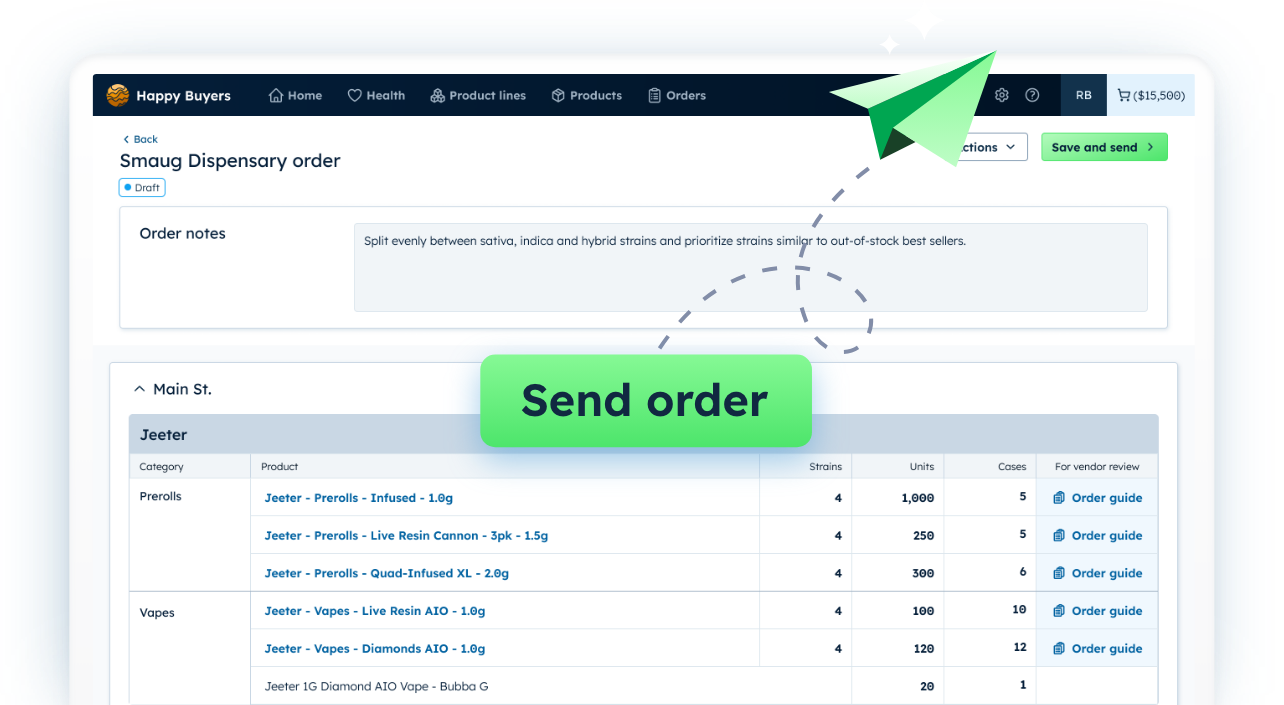
Happy Buyers dramatically reduced the operational burden of routine purchasing. For evergreen products, buyers can now generate replenishment carts in minutes instead of spending hours manually building orders. The team also began using live dashboards directly inside vendor meetings to review:
Aged inventory
Days on hand
Sell-through rates
Inventory position by brand
That created faster, more transparent conversations with wholesale partners.
The platform also helped The Botanist evolve the structure of its retail operation itself. Rather than relying on inventory coordinators to manage purchasing, the company built a dedicated buying function supported by centralized data and standardized workflows.
From November ‘25 to February ‘26, The Botanist achieved:
See the impact Happy Buyers can have on your cash flow, time, and peace-of-mind. 14 days. No risk.


.png)
.png)
.png)